
The UAE Is Building an AI Infrastructure State
Abu Dhabi’s expanding data-centre capacity and partnerships with OpenAI, Microsoft, Nvidia and G42 reveal a strategy that treats computing power as essential national infrastructure.

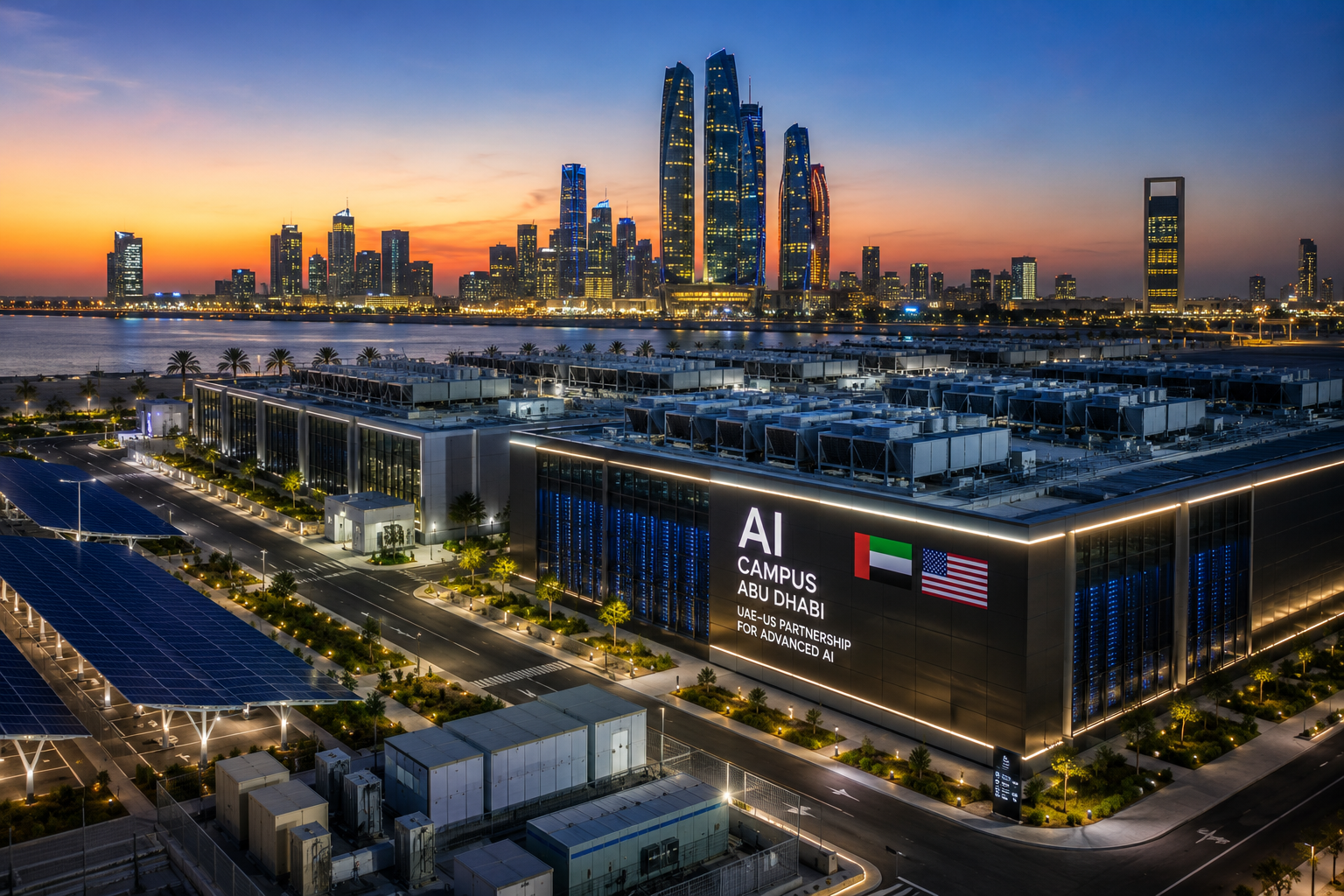
Abu Dhabi’s expanding network of data centres, global technology partnerships, sovereign investment platforms and government AI deployment suggests that the Emirates is pursuing something larger than technology adoption: an economic system organised around access to computing power.
The United Arab Emirates is moving beyond the conventional ambition of becoming a regional technology hub.
Its developing artificial intelligence strategy is increasingly centred on physical infrastructure: data centres, advanced semiconductors, cloud capacity, energy supply, sovereign computing systems, international investment and the institutions required to deploy AI across government and industry.
The result is the emergence of what can be described as an AI infrastructure state, a country treating computing capacity not simply as a commercial service, but as a strategic national asset comparable to ports, airports, energy networks and financial centres.
This approach became most visible with the announcement of the UAE–US AI Campus in Abu Dhabi. The planned five-gigawatt campus is intended to host large-scale computing infrastructure developed by G42 alongside American technology companies. Its first major component, Stargate UAE, involves OpenAI, Oracle, Nvidia, SoftBank, Cisco and G42. The initial 200-megawatt cluster is expected to become operational during 2026, with the wider Stargate facility planned to reach one gigawatt.
The scale is significant, but capacity alone does not explain the UAE’s strategy.
The country is attempting to connect infrastructure with government demand, capital, research institutions, international alliances and commercial adoption. If successful, this could make the UAE one of the few smaller economies capable of influencing several layers of the global AI value chain.
Compute is becoming national infrastructure
The economic debate surrounding artificial intelligence often focuses on software models, workplace automation and consumer applications.
Beneath those services sits a more capital-intensive system. Advanced AI depends on specialised chips, high-density data centres, electricity, cooling, fibre networks, cloud platforms, cybersecurity and engineers capable of operating complex computing environments.
Access to this system is becoming a source of national competitiveness.
Countries without sufficient domestic or trusted regional computing capacity may become dependent on external providers for critical government, financial, healthcare and industrial applications. They may also struggle to attract advanced technology companies whose operations require dependable access to cloud and AI infrastructure.
The UAE appears to have recognised this early. Rather than waiting for global providers to determine the region’s capacity, it is investing directly and forming partnerships that place significant computing infrastructure inside the country.
OpenAI described Stargate UAE as the first international deployment of its Stargate infrastructure platform. The project is being developed through the company’s OpenAI for Countries initiative and in coordination with the United States Government. OpenAI has said the partnership is intended to expand secure AI infrastructure and provide advanced technology access across the UAE and the wider region.
That structure reveals the geopolitical dimension of the project.
Frontier computing capacity is no longer governed solely by commercial demand. Access to advanced semiconductors, models and cloud systems is increasingly affected by strategic relationships, export controls, cybersecurity standards and national security considerations.
The UAE’s ability to host globally important AI infrastructure will consequently depend not only on capital and construction, but also on trust.
Abu Dhabi is assembling the institutional architecture
The UAE’s AI expansion is not being driven by one company.
G42 operates across artificial intelligence, cloud services, healthcare, data centres and advanced computing. Khazna Data Centers, part of the wider G42 ecosystem, has become a central component of the country’s infrastructure ambitions.
Khazna and Nvidia have outlined plans to design future data halls capable of supporting high-density AI workloads, with individual clusters potentially reaching 250 megawatts. Many are expected to be located within the planned UAE–US AI Campus. Khazna is also pursuing expansion across Europe, the Middle East and Africa, positioning the UAE as both a domestic computing centre and an exporter of infrastructure capability.
MGX adds a financial layer to this architecture.
Established in Abu Dhabi as an investment company focused on artificial intelligence and advanced technology, MGX has supported infrastructure projects and investments in international markets. Its portfolio includes participation in the Stargate build-out and investments connected to data-centre expansion in the United States and Europe.
This combination of state-supported capital, specialised operators and partnerships with global technology companies resembles the model the UAE previously used in aviation, logistics and finance.
In those sectors, the country did not merely invite foreign firms to sell services locally. It built airports, airlines, free zones, ports, regulatory systems and investment vehicles that allowed the UAE to become a platform connecting larger markets.
Artificial intelligence may be following the same pattern.
The strategic objective is not necessarily to produce every component domestically. It is to control enough of the surrounding infrastructure, capital and commercial relationships to become indispensable to the network.
Microsoft’s investment deepens the model
Microsoft’s relationship with the UAE illustrates how global technology companies are becoming embedded within this system.
In November 2025, Microsoft said it expected to invest a total of $15.2 billion in the UAE between 2023 and the end of 2029. The programme includes its $1.5 billion equity investment in G42, spending on cloud and AI data centres, local operations and skills development.
Microsoft said more than $7.9 billion of this expenditure was planned between the beginning of 2026 and the end of 2029. That amount includes more than $5.5 billion in capital expenditure for existing and planned AI and cloud infrastructure.
The companies have separately announced a 200-megawatt data-centre expansion intended to strengthen Microsoft Azure’s cloud and AI capacity in the UAE. Microsoft has also introduced local data processing for eligible Microsoft 365 Copilot customers, addressing demand for domestic processing, security and regulatory compliance.
These developments are commercially important because large organisations frequently delay AI adoption when they are uncertain about where sensitive data will be processed, who can access it and which regulatory framework applies.
In-country processing does not resolve every concern. It can, however, remove one of the most significant barriers facing government agencies, banks, healthcare providers and other regulated institutions.
The result is a reinforcing cycle: local infrastructure increases institutional adoption, while greater adoption improves the commercial case for additional infrastructure.
Government is intended to become the anchor customer
The UAE is not relying entirely on private demand to justify its AI investment.
Government itself is being positioned as a major adopter.
In April 2026, the federal government announced a framework intended to deploy agentic AI across 50 per cent of government sectors and operations within two years. The programme aims to use systems capable of carrying out tasks and supporting decision-making with greater autonomy than earlier generations of digital tools.
The federal strategic planning cycle for the We the UAE 2031 vision has also placed artificial intelligence within government planning, process simplification, resource optimisation and financial efficiency. Federal ministries and entities have appointed chief AI officers to lead implementation and develop institutional capability.
This approach gives the infrastructure strategy a practical source of demand.
Governments possess large volumes of administrative data and operate services involving licensing, healthcare, transport, taxation, customs, education, regulation and public communication. Even incremental improvements across these functions could produce considerable gains in processing time and administrative efficiency.
Government adoption can also create reference cases for the private sector.
A locally developed system that works reliably within a ministry, transport authority or public hospital may later be adapted for banks, insurers, logistics companies or international clients.
There are nevertheless risks.
Public-sector AI systems must be evaluated for accuracy, accountability, security, privacy and the possibility of automated decisions producing unequal or incorrect outcomes. The more autonomous the system, the more important it becomes to define where human responsibility begins and ends.
The success of the UAE’s government deployment will therefore depend on governance as much as speed.
The next challenge is productive use
Infrastructure announcements can establish ambition. They do not guarantee productivity.
A data centre creates construction spending, equipment demand and specialised employment. Its wider economic value depends on what is built using the computing capacity it provides.
The UAE will need companies capable of turning infrastructure into exportable products, scientific research, more efficient businesses and intellectual property.
The distinction is important. An economy can host large amounts of computing power while remaining primarily a buyer of foreign software and models. A more valuable position would involve using that capacity to develop applications suited to Arabic language, regional regulation, energy systems, climate conditions, logistics, healthcare and financial markets.
The UAE already possesses several advantages.
It has a high-income consumer market, digitally advanced government institutions, strong airlines and logistics networks, internationally connected financial centres and the ability to attract specialist workers. The country’s early investment in digital infrastructure has also supported unusually high levels of AI adoption.
Microsoft’s AI Economy Institute estimated that 64 per cent of the UAE’s working-age population used AI by the end of 2025, the highest measured adoption rate among the countries in its dataset.
High adoption is an encouraging signal, but routine use of consumer AI tools should not be confused with economic transformation.
The more meaningful indicators will be whether companies use AI to increase output per worker, develop new products, reduce industrial costs, improve medical research, strengthen energy efficiency and create services capable of competing outside the domestic market.
Talent remains the critical constraint
Capital can buy equipment. It cannot instantly create the people needed to operate and commercialise it.
Advanced AI ecosystems require electrical engineers, data-centre specialists, cybersecurity professionals, machine-learning researchers, software developers, product managers and executives capable of reorganising institutions around new technology.
The UAE has responded through universities, training programmes and international recruitment.
The Mohamed bin Zayed University of Artificial Intelligence has been positioned as a specialised research institution, while Dubai has launched doctoral programmes covering fields including smart cities, healthcare, sustainability and future mobility. Federal policy also identifies workforce capability and digital skills as components of the UAE Artificial Intelligence Strategy 2031.
Microsoft’s investment programme contains a workforce-development component, including its Elevate UAE initiative and professional credentialling programmes.
The deeper test will be retention.
Global demand for AI talent is intense. Researchers and senior engineers often have opportunities in the United States, Europe and Asia. The UAE must therefore offer more than competitive compensation. It needs challenging work, access to computing resources, credible research environments, career mobility and the possibility of building companies with international reach.
Domestic talent development is equally important.
A strategy dependent almost entirely on imported expertise may build capacity quickly, but it will struggle to create deep and durable knowledge within the national economy.
Energy will determine the true scale
The planned five-gigawatt UAE–US AI Campus highlights another central issue: artificial intelligence is becoming an energy industry.
Large AI data centres require dependable electricity and extensive cooling. Their energy consumption can influence grid planning, water use, land allocation and the economics of power generation.
The UAE enters this challenge with a diversified energy system that includes hydrocarbons, nuclear power and large-scale solar development. This provides a stronger foundation than is available in many emerging technology markets.
However, the energy advantage must be translated into efficient operations.
The long-term competitiveness of the campus will depend on power prices, system reliability, cooling technology and the ability to demonstrate that major infrastructure projects are consistent with wider sustainability commitments.
The location of data centres may also affect their economics. Facilities supporting time-sensitive regional services need strong connectivity and proximity to users, while other computing workloads may be located wherever power and land are most efficient.
A sophisticated infrastructure strategy will therefore distinguish between different types of demand rather than treating every data-centre project as identical.
Trust is the strategic currency
The UAE’s AI programme is being built at the intersection of American technology, Emirati capital and global demand.
This position offers influence but also exposes the country to geopolitical pressure.
The Stargate UAE announcement was presented as a partnership coordinated with the United States Government. Its participants include some of the most important American companies in semiconductors, cloud computing, networking and artificial intelligence.
Maintaining access to those systems will require continuing confidence in cybersecurity, data governance and the end use of advanced technology.
The UAE approved a National Cybersecurity Strategy in 2025 organised around governance, protection, innovation, capacity-building and partnership.
These safeguards are not secondary to the infrastructure programme. They are part of its commercial foundation.
Governments and multinational companies will not place sensitive workloads in a jurisdiction purely because it offers inexpensive power or new facilities. They will assess legal certainty, operational resilience, data controls, political relationships and the reputation of the institutions managing the infrastructure.
In AI, trust determines access.
A platform serving markets beyond the Gulf
The potential market for UAE-based infrastructure extends far beyond the Emirates.
OpenAI said the UAE–US AI Campus could provide capacity to a region located within approximately 3,200 kilometres of Abu Dhabi, covering countries across the Middle East, Africa and Asia.
G42 and related Abu Dhabi entities are already pursuing international AI projects.
The UAE announced a $1 billion AI for Development initiative in November 2025 to support AI and digital infrastructure projects in African countries. G42 has also entered partnerships involving sovereign AI and supercomputing capacity in India and Vietnam.
This suggests that the UAE does not view its infrastructure solely as a domestic utility.
Its companies could finance, construct and operate AI systems abroad, while Abu Dhabi-based funds acquire exposure to global data-centre and semiconductor growth.
That model resembles the international expansion of Emirati port, energy and aviation companies. Domestic capability becomes the base for a global network.
The measure of success
The UAE has assembled many of the components required for an AI-centred economy: capital, political commitment, infrastructure operators, international partnerships, government demand and access to global talent.
The next stage will be more difficult.
Success should not be measured only by megawatts of announced capacity or the value of investment commitments. It should be judged through utilisation rates, private-sector productivity, commercially successful companies, research output, exports, skilled employment and the reliability of systems deployed in public life.
The country must also prevent infrastructure scale from producing excessive concentration.
An ecosystem dominated by a small number of state-supported companies and foreign technology providers could become efficient without becoming broadly innovative. Start-ups, universities and independent developers need practical access to computing capacity, procurement opportunities and capital.
The strongest version of the UAE’s strategy would treat its data centres as shared economic infrastructure rather than isolated corporate assets.
That would allow a healthcare researcher, logistics company, government agency or regional software business to build on a common national platform.
From an oil state to a compute state
The UAE is not abandoning the energy economy that created its wealth.
It is attempting to use that wealth, energy capacity and institutional experience to secure a position in an emerging computing economy.
The strategy contains familiar elements of the Emirati development model: invest ahead of demand, establish globally connected infrastructure, attract leading international companies and use the domestic market as a launch platform for regional expansion.
The difference is that AI infrastructure is more politically sensitive, technologically concentrated and dependent on trust than aviation or logistics.
The UAE will need to balance openness with security, speed with governance and global partnerships with the development of domestic capability.
If it succeeds, the country will have built more than a collection of data centres.
It will have created an economic architecture in which computing power becomes a foundation for government, capital, science and industry, an AI infrastructure state designed to serve markets considerably larger than its own.
More from Culture & Society Desk

Saudi Arabia’s GenAI Adoption Shows the Next Vision 2030 Challenge Is Skills
New research points to wide use of generative AI in Saudi Arabia, but also uneven understanding, privacy concerns…

GCC Workforce Readiness Becomes the Missing Link in the Region’s AI Build-Out
Research on Gulf AI strategies suggests regulatory coherence and skills may matter as much as capital expenditure on…

Desert Data Centres Put the Middle East’s AI Ambition under a Sustainability Test
As Gulf states compete for AI infrastructure, energy efficiency and cooling strategy are becoming strategic questions, not technical…