
Saudi Arabia’s Vision 2030 Enters Its Value-Realisation Phase
Saudi Arabia is moving from rapid scale-building to value realisation. The decisive question is whether state-led investment can now produce productive private capital, exports, jobs and sustainable returns.

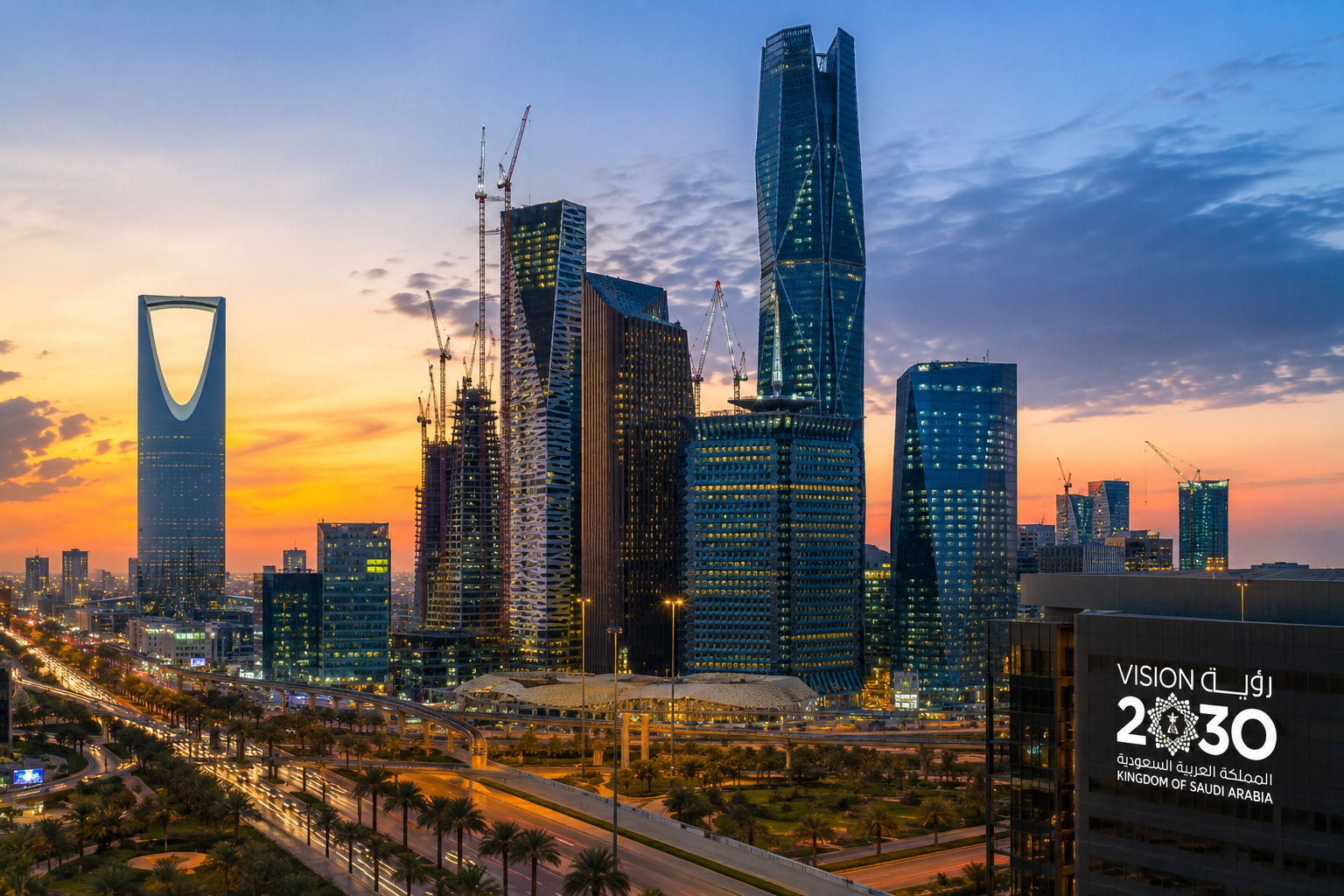
The next test is no longer whether the Kingdom can launch ambitious projects, but whether it can convert a decade of institution-building into durable private-sector growth, productivity and returns.
The end of the launch decade
Saudi Arabia’s economic transformation is entering a more exacting stage.
For much of the past decade, the most visible expression of Vision 2030 was scale: new institutions, new sectors, giga-projects, tourism assets, industrial programmes, entertainment destinations and a sovereign investment fund with an expanded domestic mandate.
In 2026, the centre of gravity is moving. The question is no longer whether the Kingdom can announce and capitalise ambitious platforms. It is whether those platforms can generate operating performance, private investment, productivity and repeatable economic value.
That change is explicit in the Public Investment Fund’s strategy for 2026 to 2030. PIF describes the period as a transition from rapid growth and acceleration towards sustained value creation, greater investment efficiency, stronger governance and increased private-sector participation.
The fund has reorganised its investments into three portfolios: the Vision Portfolio, Strategic Portfolio and Financial Portfolio. The Vision Portfolio will concentrate on six domestic ecosystems, including tourism, urban development, advanced manufacturing, logistics, clean energy and NEOM.
The language of the strategy matters because it signals a transition from institution-building to institution-testing. Assets must work together. Portfolio companies must mature. Domestic ecosystems must become commercially coherent. Public capital must attract, rather than permanently substitute for, private capital.
A stronger economic base than in 2016
The Kingdom enters this phase with a materially broader economic base than it had when Vision 2030 was launched in 2016.
Saudi Arabia’s official Vision 2030 Annual Report for 2025 said non-oil activity accounted for approximately 55 per cent of gross domestic product. The Saudi economy expanded by 4.5 per cent during 2025, while non-oil activity grew by 4.9 per cent.
The International Monetary Fund similarly reported that Saudi GDP grew by 4.5 per cent in 2025, supported by the unwinding of some OPEC+ production restrictions and robust non-oil activity driven by domestic demand.
These changes do not eliminate the importance of oil revenue. They alter the structure through which that revenue is converted into domestic demand, investment, infrastructure and employment.
The significance of the non-oil share is not simply statistical. A diversified economy becomes resilient only when its newer sectors begin creating their own customers, suppliers, skills and export channels.
Tourism that depends almost entirely on continuing public subsidy is not yet a mature industry. Manufacturing that lacks competitive logistics and reliable domestic suppliers is not yet an ecosystem. A technology programme that buys infrastructure without developing commercial adoption and specialist talent remains a capital project rather than a productivity engine.
The final years of Vision 2030 will consequently be judged by economic depth, not merely by the number of sectors that have been launched.
PIF’s new organising principle
Under its latest strategy, PIF intends to connect investments that were previously viewed as separate assets.
The Vision Portfolio is designed to develop six competitive domestic ecosystems and create stronger commercial relationships among portfolio companies. Its purpose is to identify cross-sector opportunities, increase private participation and improve the economic value generated by strategic assets.
That is a more difficult undertaking than launching companies.
Integration forces decisions about priorities, capital allocation and performance. It requires managers to demonstrate how one investment supports another, whether portfolio companies are purchasing from each other for valid commercial reasons and whether domestic supply chains are becoming more competitive.
During the growth phase, the strategic importance of a project could be sufficient to justify early capital. During the value-realisation phase, management teams must explain why an asset should continue receiving capital, what returns it can achieve, how it supports the wider economy and when it can stand on a more commercial footing.
This does not mean every strategic investment should be evaluated like a listed company reporting its next quarter. National infrastructure and the creation of new industries frequently require patient capital.
It does mean that the distinction between strategic patience and weak execution must become clearer.
The private sector is now the central test
Saudi Arabia’s private sector has long been described as a partner in Vision 2030. The latest PIF strategy makes that partnership more operational.
Private companies are expected to invest, supply, operate, innovate and increasingly share commercial risk. PIF has said its strategy will create additional opportunities for domestic businesses to participate as investors, partners and suppliers.
This transition is essential because no sovereign fund, however large, can construct a diversified economy through direct ownership alone.
Durable diversification requires thousands of companies making independent investment decisions based on demand, price, productivity and commercial opportunity.
The quality of private-sector participation matters more than the headline value of awarded contracts.
A construction contract can create immediate economic activity, but it does not automatically create an internationally competitive contractor. A local-content rule can stimulate domestic production, but poorly calibrated requirements can increase costs or protect suppliers that do not improve their performance.
The strongest outcome would be a market in which Saudi businesses gain transferable capabilities, foreign companies share knowledge because doing so is commercially rational and procurement systems reward delivery rather than proximity to public spending.
The IMF has welcomed PIF’s greater focus on selective capital allocation and private-sector crowding-in. It has also identified improvements to the business environment, deeper capital markets, stronger support for small and medium-sized businesses and better alignment between education and labour-market demand as continuing priorities.
Execution discipline becomes economic policy
The coming years will place greater pressure on sequencing.
Large developments compete for engineering capacity, imported materials, skilled labour, financing and management attention. When too many projects reach their most intensive construction stages simultaneously, costs can rise while delivery standards weaken.
A value-realisation strategy therefore requires more than financial modelling. It requires realistic schedules, disciplined procurement, transparent milestones and the willingness to resize or defer projects when their economic cases change.
This should not automatically be interpreted as a retreat from ambition. It is how ambition becomes credible.
The most successful state-led transformations are rarely those that execute every original proposal exactly as it was first presented. They are those that preserve their strategic direction while adjusting design, pace and capital intensity in response to evidence.
Saudi Arabia’s ability to make those adjustments without weakening confidence among investors, contractors and international partners will be one of the defining governance tests of the closing period of Vision 2030.
It will also determine whether public capital can be moved away from underperforming assets and towards infrastructure or industries capable of producing stronger economic returns.
Resilience has acquired strategic value
Regional instability during 2026 added another dimension to Saudi Arabia’s economic strategy.
The disruption of maritime activity through the Strait of Hormuz affected trade and energy shipments across the Gulf. Saudi Arabia, however, benefited from its large domestic market and its ability to reroute oil and cargo towards ports on the Red Sea.
The IMF said the Kingdom’s diversified infrastructure, prompt use of the East-West oil pipeline and Red Sea ports helped limit the disruption to oil deliveries. It nevertheless warned that a prolonged conflict could damage investor confidence and weaken medium-term growth and diversification.
Reuters also reported that Saudi Arabia weathered the disruption better than several neighbouring economies, supported by domestic consumption, logistical alternatives and continued non-oil business activity. The Kingdom’s non-oil private sector recorded stronger expansion in May as demand improved and previously delayed projects restarted.
That resilience strengthens the argument for diversification, but it should not create complacency.
A large domestic market can cushion external shocks. Prolonged geopolitical instability can still increase financing and insurance costs, affect tourism, delay investment decisions and alter project schedules.
The more useful conclusion is that infrastructure redundancy, domestic demand and a broader production base provide strategic insurance. The next task is to make that insurance progressively less dependent on continued fiscal stimulus.
What investors should measure next
The most useful indicators for the value-realisation phase will differ from those that dominated the launch years.
Investors will continue to monitor project pipelines, assets under management and capital expenditure. The more revealing measures, however, will be operating cash flow, private co-investment, export intensity, supplier productivity, return on invested capital and the number of businesses capable of expanding without relying on a single public-sector customer.
Labour-market data will also require more careful interpretation.
Job creation remains important, but productivity, wage progression and the relationship between training programmes and genuine private-sector demand will determine whether employment gains are sustainable.
The same distinction applies to foreign investment.
Capital used to establish production, research capabilities, regional decision-making centres or long-term infrastructure has a different economic effect from capital entering for a single construction cycle or financial transaction.
The number of regional headquarters established in Riyadh is a useful indicator of business interest. Their eventual economic value will depend on whether they contain senior management, procurement authority, research functions and regional budgets rather than limited administrative offices.
The credibility dividend
Saudi Arabia has demonstrated that it can change regulation, consumer markets and the physical character of its cities at unusual speed.
The remaining opportunity is a credibility dividend: the additional investment and lower risk premium that emerge when global partners believe projects will be governed consistently, contracts will be executed predictably and capital will be allocated with discipline.
That dividend cannot be created through communication alone. It develops through repeated evidence.
A project completed on a revised but transparent schedule can strengthen credibility. A portfolio company that reports clearly and attracts independent investors can strengthen credibility. A procurement process that provides smaller companies with genuine access can strengthen credibility.
Over time, these decisions will determine whether Vision 2030 is remembered primarily as a period of extraordinary state expenditure or as the foundation of a more productive economic system.
The emphasis on investment efficiency and governance in PIF’s new strategy indicates that Saudi decision-makers recognise the importance of this transition. The strategy also states that the fund will maintain a disciplined focus on value realisation, sustainable returns and capital efficiency.
A regional benchmark for economic transition
Saudi Arabia’s experience is becoming a regional benchmark.
Other resource-rich economies are studying how the Kingdom combines sovereign investment, regulation, urban development and social reform. The lesson, however, is not that every country should attempt to reproduce Saudi scale.
It is that transformation requires institutions capable of choosing priorities, coordinating delivery and revising policy when results fall short.
The comparison will become sharper as financing conditions tighten and public budgets face competing demands.
Projects that create exports, productive employment or essential infrastructure will be easier to defend than assets whose economic purposes remain unclear. This increases the importance of independent evaluation, transparent performance reporting and realistic assessments of opportunity costs.
A mature transformation programme should be able to identify underperformance without treating it as a rejection of the wider national vision.
For international companies, this transition also changes the commercial proposition.
Early participation was frequently driven by the size of announced project pipelines. Future participation will depend more heavily on payment certainty, procurement quality, the availability of local talent, dispute resolution and the possibility of developing a profitable regional operation.
The value-realisation phase will therefore test international partners as well as Saudi institutions. Companies will need to contribute capability, technology and management expertise, rather than simply adding capacity to publicly funded projects.
From transformation to normalisation
The ultimate measure of Vision 2030 will be whether its reforms become normal economic behaviour.
New sectors should eventually stop being described as new. Private companies should not have to frame every investment as participation in a national programme. Consumers, workers and investors should experience a market in which diversified economic activity is routine, institutions are dependable and opportunity is not confined to a small number of state-backed platforms.
The value-realisation phase is therefore the most consequential part of Saudi Arabia’s transformation.
Launching new assets captured the world’s attention. Integrating them, commercialising them and opening them to broader private participation will determine their legacy.
The Kingdom has built the machinery of transformation. The years leading to 2030 will show how efficiently that machinery can produce lasting value.
More from Farah Al-Khatib

Gulf Oil Producers Rush to Monetise Reserves as the Energy Transition Clock Ticks
The strategic push to extract more value from oil before demand weakens is reshaping production choices, fiscal planning…

Indian Travellers Become a Key Test Market for Middle East Tourism Recovery
The UAE, Saudi Arabia and Oman are looking to India’s outbound travel base as conflict and uncertainty weigh…

Saudi Arabia’s 2026 Budget Deficit Shows Vision 2030 Entering a Harder Spending Phase
The kingdom’s fiscal plan keeps transformation spending alive while signalling sharper discipline around priority sectors and project sequencing.