
Dubai’s Flexible Summer Work Model Expands Public-Sector Reform
Dubai’s flexible summer work model is part of a wider shift toward human-centred public administration and productivity reform.

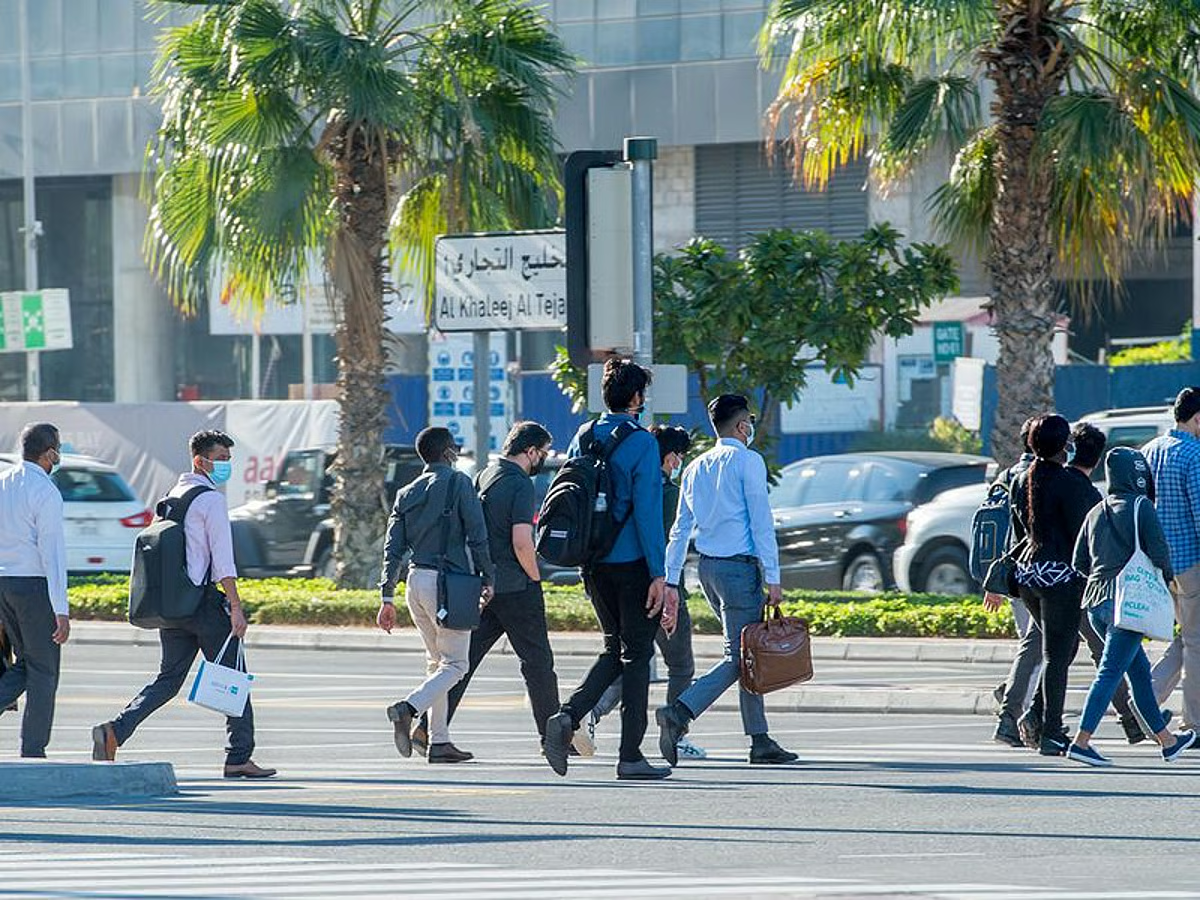
Dubai flexible summer work model has returned as government entities begin implementing the 2026 edition of ‘Our Flexible Summer’. The Dubai Media Office announcement said the initiative, launched by the Dubai Government Human Resources Department, is intended to create more flexible and human-centred government work environments. The move places work design inside the emirate’s broader public-sector reform agenda.
A public-sector policy with private-sector relevance
Flexible working hours are often discussed as an employee benefit. In Dubai’s case, they are better understood as a governance experiment. The public sector is testing how working models can be adjusted for summer conditions, family commitments and service continuity without weakening institutional performance. If the model works, it can influence how private employers think about productivity, retention and workplace design in a climate where summer conditions shape daily life.
The programme is also a signal about state capacity. Governments that can adjust working structures while maintaining service delivery show a level of administrative confidence. The challenge is not simply to reduce hours or create longer weekends. It is to redesign work so that citizens, residents and companies still receive reliable services. That requires planning, digital systems, performance measurement and managerial discipline.
The two-model approach
Local reporting has described the initiative as offering two models, including adjusted daily hours and Friday arrangements. Gulf News reported that the programme runs from 29 June to 10 September 2026 and includes different working-hour structures for groups of employees, with remote work also available depending on operational needs. The details matter because flexibility must fit the function. A counter service, inspection team and policy unit cannot all operate in the same way.
That operational nuance is important for credibility. A flexible model that is too rigid can fail because it ignores departmental realities. A model that is too loose can create service gaps. Dubai’s approach appears to give entities room to apply arrangements according to need. The governance test will be whether this decentralised application produces consistent service outcomes.
Productivity, wellbeing and retention
Public-sector productivity is increasingly linked to employee wellbeing. Long commutes, heat stress, family responsibilities and burnout can reduce performance even when formal working hours look adequate. By adjusting work patterns during the summer, Dubai is recognising that productivity is not only a measure of time at a desk. It is a measure of output, responsiveness and service quality.
The policy also speaks to talent retention. Governments in the Gulf compete with private employers, free zones, international firms and remote-work options. A public sector that offers modern working arrangements may be better placed to retain skilled professionals, especially younger employees who view flexibility as part of organisational culture. This is particularly relevant as Gulf administrations adopt more digital services, data tools and AI-enabled systems that require specialist talent.
What to watch next
The most important indicators will be service continuity, employee satisfaction, citizen feedback and whether government entities publish measurable outcomes. If the initiative improves morale while maintaining performance, it may become a more permanent part of Dubai’s public-administration toolkit. If service quality weakens, the model will need refinement.
The wider lesson is that government reform is moving beyond organisation charts and digital portals. It now includes the design of work itself. Dubai’s flexible summer model shows how climate, productivity and public service can be treated together. In a region where summer conditions are structural, that may become an increasingly important feature of institutional competitiveness.
For employers outside government, the initiative creates a benchmark rather than a direct obligation. Private companies will watch whether public entities can maintain responsiveness while giving employees more flexibility. If the model proves effective, it may encourage more firms to revisit summer schedules, hybrid policies and performance measurement. In a competitive labour market, workplace design can become part of talent strategy.
The policy is also relevant to Dubai’s wider positioning as a city for skilled professionals. Quality of life is no longer a soft factor in economic competition. It affects relocation decisions, family stability, productivity and retention. By linking flexibility to government work, Dubai is signalling that administrative reform and human-centred policy can sit within the same framework.
The article has been structured for search visibility with a clear focus keyword, concise headings, verified external references and a direct opening paragraph that explains the current news development before moving into context, risk and next steps.
Sources and context
More from Technology & AI Desk

Southern Lebanon Returns Begin, but the Risk of a Fragile Peace Remains
Families are reopening homes and businesses in the south, yet destruction, uncertainty and low-level hostilities continue to shape…
Hamas Move to Transfer Gaza Authority Opens a New Test for Reconstruction
The proposed shift to a UN-backed technocratic committee raises immediate questions over weapons, governance and who can control…

Saudi Arabia’s 2026 Budget Deficit Shows Vision 2030 Entering a Harder Spending Phase
The kingdom’s fiscal plan keeps transformation spending alive while signalling sharper discipline around priority sectors and project sequencing.