
Gaza: As world waits for Hamas response, aid teams call for ceasefire
Winter is fast-approaching and heavy ongoing Israeli military operations in Gaza City continue to drive mass displacement. “It’s important that we get that ceasefire and then we get aid flowing in not only to…

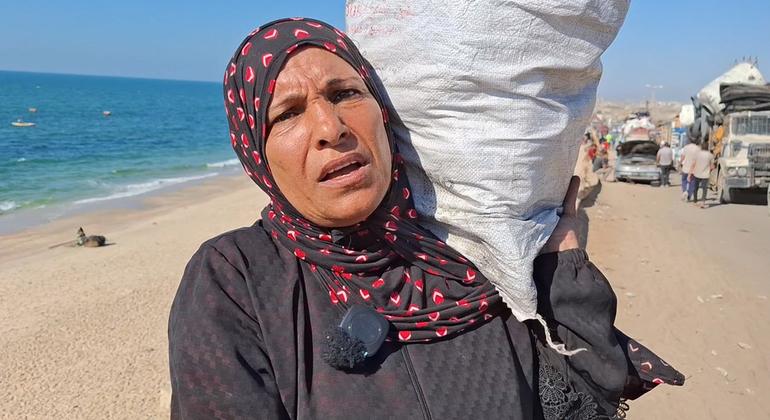
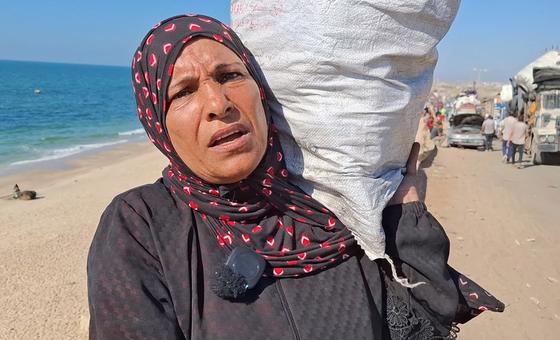
Winter is fast-approaching and heavy ongoing Israeli military operations in Gaza City continue to drive mass displacement.
“It’s important that we get that ceasefire and then we get aid flowing in not only to prevent the famine that continues to move to the south, but also to make sure that children and families are sheltered,” UN Children’s Fund (UNICEF) spokesperson Ricardo Pires told reporters in Geneva.
Mr. Pires stressed that falling temperatures in the devastated enclave will create “a whole different range of issues”, including health challenges for children and their families.
Al Mawasi overload
He highlighted the “massive” displacement happening as people flee from the north to the south. Conditions are dire in the overcrowded coastal tented settlement at Al-Mawasi which “can simply not absorb the quantity of people who are moving in”.
“We’re talking about hundreds of thousands of people, an estimated 400,000 displaced,” he insisted.
According to the UN aid coordination office (OCHA), only about 18 per cent of the Gaza Strip is not subject to displacement orders or located within militarized zones.
People who have lost their homes need shelter desperately and UNICEF has 11,000 tents as well as tarpaulin sheets “waiting to get in” to the Strip, Mr. Pires said.
“We’re not being able to get those supplies in… It just shows how the conditions in terms of logistics and facilitation of aid continue to be very, very poor,” he said.
Echoing his comments, OCHA spokesperson Jens Laerke stressed that humanitarians’ ability to distribute aid within Gaza is still compromised. Some aid has been able to enter, he said, highlighting the fact that community kitchens have been “resupplied to some extent”, with some 660,000 meals prepared and delivered through 137 kitchens across the enclave last Sunday.
Convoys still denied access
But the ability to get aid into people’s hands depends on humanitarians obtaining permission to collect and deliver it.
“Sometimes it works, sometimes it doesn’t,” Mr. Laerke explained, either because of non-facilitation by the Israeli side or for other reasons.
The UN previously said that on Sunday more than 40 per cent of the humanitarian missions that require coordination with the Israeli military were denied.
“A lot of the aid that has come in recently, that has been picked up, has been taken off the trucks by desperate people and in some cases by armed groups,” OCHA’s Mr. Laerke added.
He called the current situation “chaotic” and underscored the “absolute” need for a ceasefire as soon as possible so that humanitarians can resume “a proper and well-coordinated, well-supplied aid operation”.
More from Omar Rahmani

From Mumbai to the Middle East: Sundeep Kochar and the Global Journey of Vedic Guidance
Sundeep Kochar’s international career reflects how Indian traditions travel through diaspora communities and acquire new meanings in modern,…

Gulf Markets Slip as Hormuz Risk Returns to the Centre of Regional Pricing
Renewed tension around the Strait of Hormuz is again forcing investors to price security, energy and sovereign risk…

Israel Floats Hormuz Bypass Pipeline as Gulf Energy Security Debate Deepens
A proposed Saudi–Eilat–Ashkelon route has revived questions about whether Gulf exports need new physical corridors beyond the Strait…