
Songs of hope rise from Gaza’s ruins
Among them is Ahmed Abu Amsha, a music teacher who has become something of a humanitarian troubadour. Fleeting moments of joy Living in a worn tent with his family, he refuses to let despair…

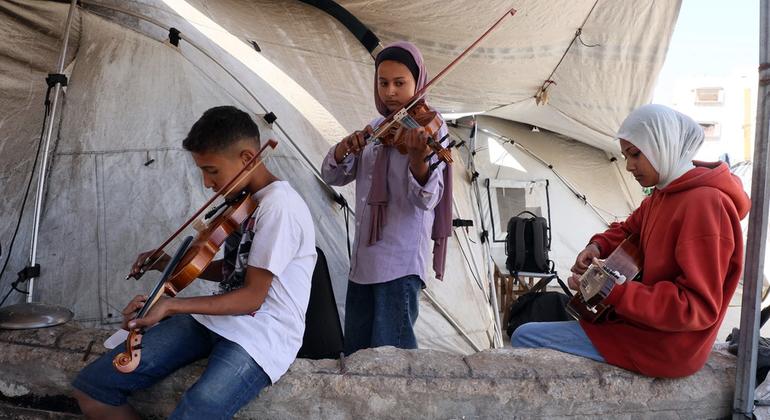
Among them is Ahmed Abu Amsha, a music teacher who has become something of a humanitarian troubadour.
Fleeting moments of joy
Living in a worn tent with his family, he refuses to let despair drown out hope. Instead, he teaches music to displaced children, helping them find moments of joy through rhythm and song.
Originally from Beit Hanoun, Abu Amsha is a guitar instructor and regional coordinator at the Edward Said National Conservatory of Music. Since the war began, his family has been displaced 12 times. Each time they fled, they took their instruments.
“They’re the only thing that keeps us hopeful,” he said, sitting beside bottles of water outside his tent, a guitar resting gently in his lap.
Daily horror
Daily life in the camp is a grind of hardship – narrow alleys, water queues, a constant struggle to survive. Yet within this bleakness, Abu Amsha has created something extraordinary: Gaza Bird Singing (GBS), a musical group made up of displaced children with budding talents.
The idea came during a period of displacement in Al-Mawasi, Khan Younis, where he began training children to sing and play. The group has since performed in various camps, their music echoing on social media and offering a rare glimpse of hope amid rubble.
Clinging to music
His son Moein, who plays the ney – an end-blown wind instrument similar to a flute – carries his instrument wherever they go. “We’ve been displaced more than 11 times, and I always carry my ney with me. It’s the only thing that helps me forget the sound of the bombing,” he said.
Finding a quiet space is hard, but they try to practise inside their tent, cocooned from chaos.
For Yara, a young violinist learning under Abu Amsha’s guidance, each new displacement deepens her anxiety. “But whenever I’m scared, I play. Music makes me feel safe,” she said.
Under the tarpaulin roofs of the camp, children gather to play, plucking strings, blowing wind instruments, tapping rhythms into existence – trying to transcend the horrific soundtrack of war.
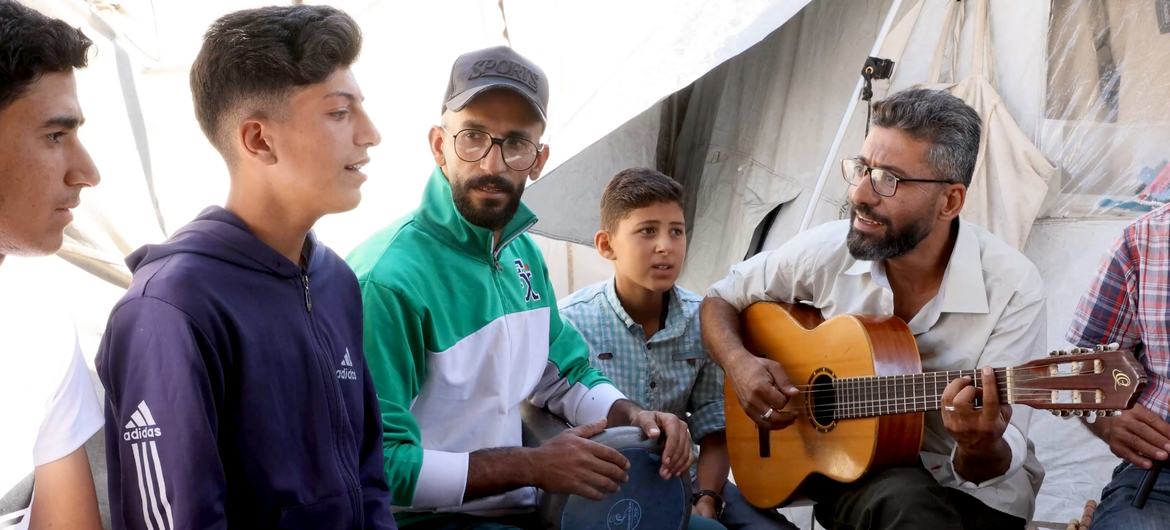
Ahmed Abu Amsha (right, with guitar) surrounded by children who play, sing and learn music.
Sacred space
In a place stripped of necessities, the sound of music feels both surreal and sacred.
Yet Abu Amsha remains steadfast in his mission. “We sing for peace, we sing for life, we sing for Gaza,” he says softly, as the melody of the oud rises behind him – a fragile beauty in a scene shattered by war.
More from Omar Rahmani

From Mumbai to the Middle East: Sundeep Kochar and the Global Journey of Vedic Guidance
Sundeep Kochar’s international career reflects how Indian traditions travel through diaspora communities and acquire new meanings in modern,…

Gulf Markets Slip as Hormuz Risk Returns to the Centre of Regional Pricing
Renewed tension around the Strait of Hormuz is again forcing investors to price security, energy and sovereign risk…

Israel Floats Hormuz Bypass Pipeline as Gulf Energy Security Debate Deepens
A proposed Saudi–Eilat–Ashkelon route has revived questions about whether Gulf exports need new physical corridors beyond the Strait…