
UAE Stock Markets Fall as Weak Earnings and Regional Tensions Worry Investors
UAE stock markets ended lower on Friday as weak corporate earnings and rising regional tensions affected investor confidence. Dubai's main index fell for a third consecutive session, while Abu Dhabi also recorded a decline.

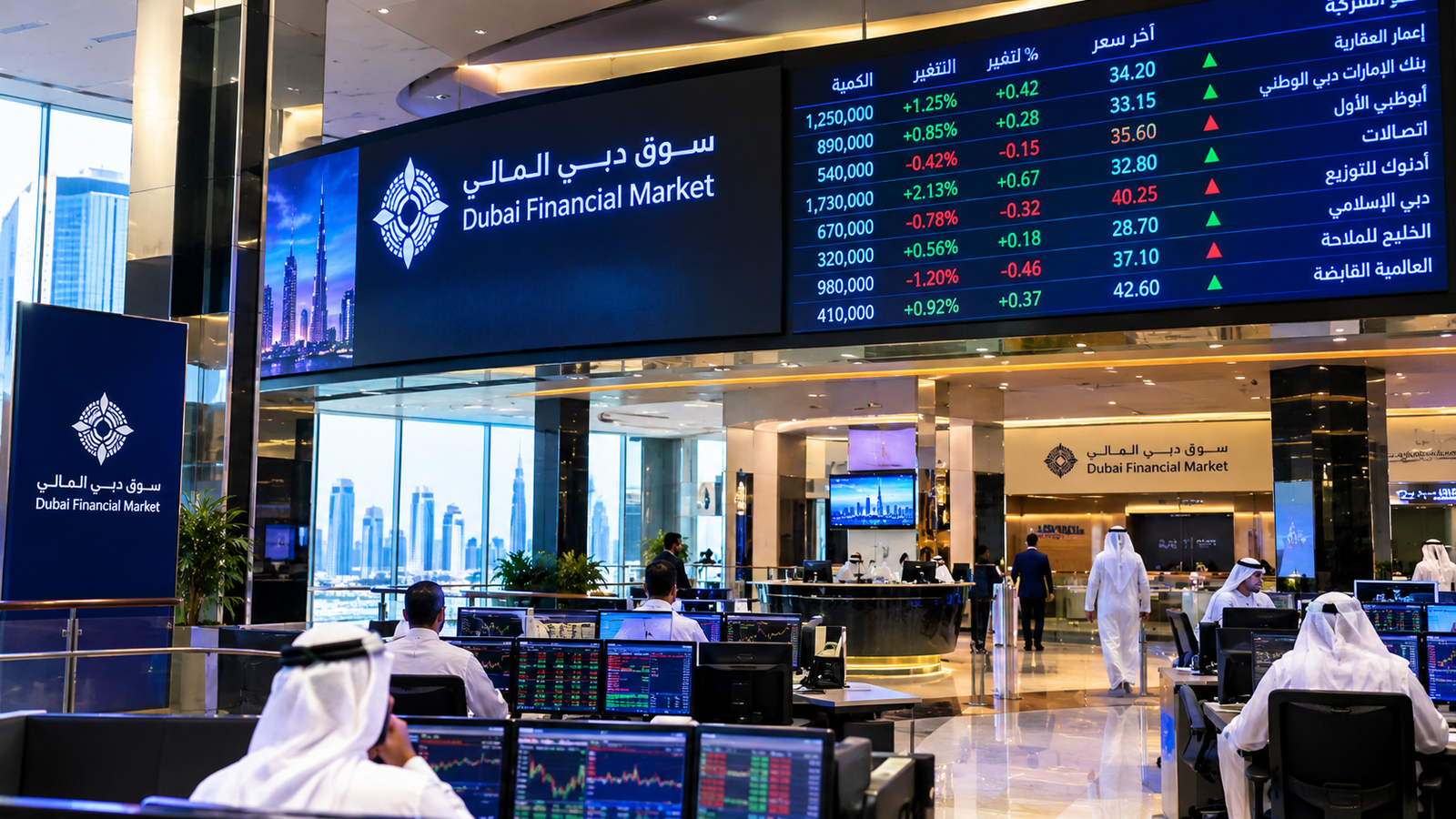
Stock markets in the United Arab Emirates ended lower on Friday, 30 October, as weaker corporate earnings and rising regional tensions affected investor confidence.
Dubai’s main stock market index fell by 0.8%, extending its decline for a third consecutive trading session. Abu Dhabi’s benchmark index also moved lower, although its decline was smaller at 0.1%.
The latest market performance reflects growing caution among investors. Concerns about regional security, combined with disappointing company results, have placed pressure on several major UAE-listed businesses.
According to Reuters, losses in banking and real estate shares contributed to the decline in Dubai. Banking, energy and investment-related stocks also weighed on Abu Dhabi’s market.
Dubai Market Extends Its Losing Streak
Dubai’s main stock index recorded another decline on Friday, continuing a three-session losing streak.
Major companies contributed to the downward movement. Emirates NBD, one of Dubai’s largest banks, fell by 1.1%. Shares of leading property developer Emaar Properties declined by 0.9%.
The Dubai Financial Market, which operates the emirate’s stock exchange, also came under pressure. Its shares dropped by 1.6%.
The company reported a 4.3% decline in third-quarter net profit. Its total income also fell by 4.1%, according to the Reuters report.
These results added to investor concerns about the performance of listed companies during a period of wider economic uncertainty.
Dubai’s market has also faced pressure from developments affecting the region’s financial and commercial environment.
Abu Dhabi Shares Also End Lower
Abu Dhabi’s stock market recorded a smaller decline than Dubai on Friday.
Its benchmark index slipped by 0.1%, with losses in banking and energy-related shares contributing to the movement.
Abu Dhabi Islamic Bank fell by 3.9%, while ADNOC Distribution declined by 1.3%.
Two Point Zero Group also recorded a decline. The company’s shares dropped by 2.5% after it reported a 25% fall in third-quarter net profit to AED1.51 billion.
The results attracted attention because large companies play an important role in the performance of the UAE’s financial markets.
Although Abu Dhabi’s daily decline remained limited, the index finished the week with a loss of 1.3%.
Regional Tensions Add to Investor Concerns
Financial markets across the Gulf remain sensitive to developments in the wider Middle East.
Reports of attacks affecting Saudi infrastructure and incidents involving commercial vessels near the Strait of Hormuz have increased concerns about regional security.
Investors are also monitoring developments involving the United States and Iran. According to Reuters, a report by the Wall Street Journal said the senior US military officer overseeing the Middle East had discussed military options concerning Iran with President Donald Trump.
These developments have increased uncertainty about the regional business environment.
For investors, geopolitical risks can influence decisions about banks, property companies, energy businesses and other major sectors.
However, market movements cannot be linked to one event alone. Company earnings, oil prices, interest rates and international financial conditions can also influence share prices.
Rising Oil Prices Remain Important for Gulf Markets
Oil prices increased on Friday as traders assessed the possibility of further escalation involving the United States and Iran.
Brent crude rose by 2.3% to reach $117.56 per barrel at 11:50 GMT, according to Reuters.
Oil prices are particularly important for Gulf economies because energy revenues influence government finances, investment activity and wider economic conditions.
Higher oil prices can support revenues for energy-producing countries. At the same time, uncertainty about supply and shipping routes can create additional risks for businesses and investors.
The direction of oil prices will therefore remain an important factor for regional financial markets.
Dubai and Abu Dhabi Record Different Weekly Results
Despite Friday’s declines, the two UAE markets recorded different results for the full week.
Dubai’s main index gained 0.6% over the week, while Abu Dhabi’s benchmark index lost 1.3%, according to data compiled by LSEG and cited by Reuters.
The difference shows that daily market movements do not always reflect the performance of an entire trading week.
Investors will continue to assess company earnings, regional developments and changes in international energy markets as they consider their next investment decisions.
What Investors Will Watch Next
The UAE remains an important financial centre for international investors. Its stock markets provide access to major banking, property, energy and investment companies.
However, recent market movements show that investor confidence can change quickly when corporate results and regional security concerns combine.
In the coming sessions, investors are likely to monitor new company earnings, oil price movements and developments across the Middle East.
For now, Friday’s market performance highlights a cautious mood across the UAE’s financial sector. Whether that caution continues will depend on how regional conditions develop and how listed companies perform in the final months of 2026.
More from Naveen Mehta
OPEC+ Expected to Hold Oil Output Targets Steady Ahead of Sunday Meeting
OPEC+ members are expected to hold oil output targets steady at their 1 November meeting as Middle East…

Middle East Oil Disruptions Keep Global Supply Under Pressure
Oil exports from the Gulf have partly recovered, but shipping risks, damaged energy facilities and tight diesel supplies…

Saudi Arabia’s Vision 2030 Enters Its Value-Realisation Phase
Saudi Arabia is moving from rapid scale-building to value realisation. The decisive question is whether state-led investment can…